

This article clarifies the three common meanings of 5 potassium nitrate—5 moles, 5 grams, and 5% concentration. It shows how molar mass from IUPAC atomic weights gives 505.516 grams for 5 moles, how to convert 5 grams to moles and molecules, and elemental composition. It explains 5% w/v as 50 mg/mL and why 5% potassium nitrate is the benchmark desensitizing level in toothpaste, contrasting it with nano-hydroxyapatite approaches.
- Five moles of potassium nitrate weighs 505.516 grams when calculated from its molar mass of 101.1032 grams per mole.
- Potassium nitrate has formula KNO3 and its molar mass derives from potassium 39.0983, nitrogen 14.007, and oxygen 15.999.
- A 5% w/v potassium nitrate solution means 5 grams per 100 mL, which equals 50 mg per mL.
- Toothpastes use 5% potassium nitrate as a depolarizing agent that lets potassium ions travel into dentin tubules to calm nerve firing.
- Percent w/v is calculated as mass in grams divided by volume in milliliters multiplied by 100.
5 Potassium Nitrate: The Quick Answer
5 moles of potassium nitrate (KNO₃) weighs 505.516 grams, based on potassium nitrate's formula KNO₃ and a molar mass of 101.1032 grams per mole.
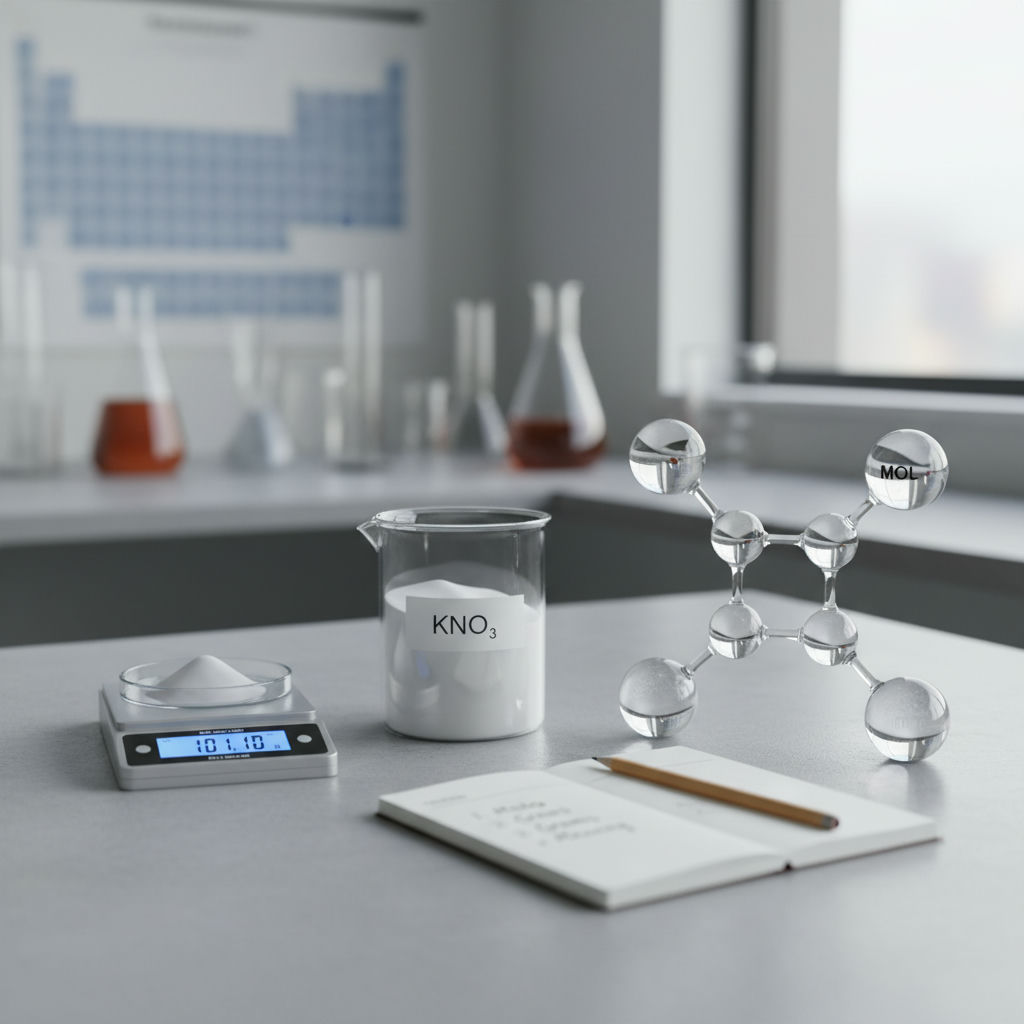
If you're standing at the balance to make a lab batch or solving a stoichiometry problem, that 505.516-gram total is the value you actually weigh or calculate. The phrase '5 potassium nitrate' can also be typed to mean 5 grams of KNO₃ or a 5% potassium nitrate solution, two very different quantities. This article separates all three (moles-to-grams, grams-to-moles, and percent concentration), and from the headline number, the next step is showing exactly how that figure is derived.
Calculating Moles, Grams, and Molecules of KNO₃
Potassium nitrate (KNO3) converts between moles and grams using its molar mass, which is built from IUPAC 2023 standard atomic weights: potassium 39.0983, nitrogen 14.007, and oxygen 15.999. That means M(KNO3) = 39.0983 + 14.007 + 3×15.999, and all mole-gram-particle conversions flow from that sum.
With the direct answer stated, here is the arithmetic behind it, worked in full.
1. Derive molar mass from atomic weights
Molar mass is the sum of the standard atomic weights for each atom in the formula:
- K: 39.0983(1) from the IUPAC atomic-weights table
- N: 14.007(1) in the same IUPAC table
- O: 15.999(1) in the same IUPAC table
So:
M(KNO3) = 39.0983 + 14.007 + 3 × 15.999
2. Mass of 5 moles
The central relation is mass = moles × molar mass.
mass = n × M = 5 mol × KNO3 molar mass defined in PubChem as KNO3
Expressed with the atomic-weight values above:
mass(5 mol) = 5 × (39.0983 + 14.007 + 3 × 15.999) grams
3. How much is 5 grams in moles and molecules
The inverse relation is moles = mass / molar mass.
n = 5 g / M(KNO3) = 5 g / (39.0983 + 14.007 + 3 × 15.999) g/mol
To get particle count, multiply by Avogadro's number (N_A):
molecules = n × N_A
In practice you calculate n first, then multiply by N_A to get formula units of KNO3. Keeping the calculation as written lets you verify each step against the primary IUPAC atomic weights and the PubChem record for potassium nitrate.
Elemental Composition and Other Concentrations of Potassium Nitrate
PubChem documents potassium nitrate with formula KNO3 and an elemental mass breakdown of 38.7% potassium, 13.0% nitrogen and 48.3% oxygen by mass. Beyond a single mass figure, potassium nitrate shows up in several different '5' contexts worth telling apart.
How the percentages are derived
Potassium nitrate contains one potassium, one nitrogen and three oxygens. Percent composition is calculated, not simply looked up: it comes from (atoms × atomic weight / molar mass) × 100 for each element using IUPAC atomic weights. Summing those contributions gives the total molar mass, and dividing each element's contribution by that total produces the mass fractions reported above. This method lets any student reconstruct the numbers from a periodic table rather than memorizing them.
What 5% potassium nitrate actually means
In solution chemistry, percent has its own rules. The formula for percent weight/volume is % w/v = (mass in g ÷ volume in mL) × 100. A 5% w/v solution contains 5 grams of solute per 100 mL of solution. The same source notes the conversion between percent and milligrams per milliliter as 5% w/v = 50 mg/mL.
For w/w, percent expresses mass of solute per 100 grams of total solution, which matters when both components are weighed rather than volumetrically measured.
| Interpretation | What It Means | Key Figure | Typical Use Context |
|---|---|---|---|
| 5 moles KNO3 | Quantity equal to 5 × molar amount of formula units | — | Stoichiometry homework, batch lab prep |
| 5 grams KNO3 | Mass weighed directly on a balance | 5 g solid | Direct weighing, fertilizer dosing, lab reagents |
| 5% KNO3 solution | — | 5 g per 100 mL = 50 mg/mL | Desensitizing oral-care products, pharmacy compounding |
In a chemistry homework context, '5 potassium nitrate' most often means 5 moles of KNO3, but in consumer and clinical labels the figure that matters is 5% concentration.
Recognizing which '5' you need avoids over- or under-dosing by an order of magnitude, and one of those contexts (the 5% concentration) turns out to matter well beyond the chemistry classroom.
Why a 5% Potassium Nitrate Concentration Matters for Sensitive Teeth
Does a desensitizing product need 5% potassium nitrate to help with whitening sensitivity? Yes, 5% potassium nitrate is the benchmark used in many dentist-recognized desensitizing toothpastes because potassium ions help quiet nerve response inside the tooth.
Enamel Safe Whitening.
That 5% figure is not only a chemistry-class number; it shows up directly on oral-care ingredient labels. Formulations contain 5% potassium nitrate (KNO3), and potassium ions can travel into exposed dentin tubules from the tooth surface to reach internal nerves, where a buildup helps prevent the nerve from firing pain signals after cold, heat, or peroxide exposure. Clinical references describe potassium nitrate as a depolarizing agent which numbs the nerve of sensitive teeth rather than physically plugging tubules. The regulatory footing is established: such products may contain up to 5% potassium nitrate as a tooth desensitizing ingredient under Title 21, Code of Federal Regulations Part 355.
nanoWHITE takes a different route to the same sensitivity problem. Its formulas address sensitivity through nano-hydroxyapatite remineralization plus coconut oil-infused gels rather than relying on potassium nitrate to depolarize nerves. That positions it as a genuine alternative approach, not a product that contains 5% potassium nitrate itself.
When you compare labels, use the 5% figure as a practical filter. If a paste lists potassium nitrate, check the Drug Facts panel for 5% potassium nitrate and directions for twice-daily use over several weeks. If you prefer a remineralization-based approach, look for nano-hydroxyapatite listed as a key care ingredient and clear instructions for contact time during whitening, so you know how the product is intended to support enamel while you whiten.
Frequently Asked Questions
How much does 5 moles of potassium nitrate weigh?
Use mass = moles × molar mass. With a molar mass of 101.1032 g/mol for KNO3, five moles equals 505.516 grams. That is the amount you would weigh for a batch or stoichiometry calculation.
I have 5 grams of potassium nitrate — how many moles is that?
Divide the weighed mass by the molar mass: n = mass / M. For KNO3 that is 5 g / 101.1032 g/mol, which is well under one tenth of a mole. Multiply that result by Avogadro's number to get formula units.
What does 5% potassium nitrate mean in w/v versus w/w?
% w/v is defined as % w/v = (mass in g ÷ volume in mL) × 100, so 5% w/v means 5 g per 100 mL, which equals 50 mg/mL. 5% w/w means 5 g of solute per 100 g of total solution, used when both parts are weighed.
Is 5% the typical concentration in sensitive-teeth toothpaste?
Yes, many desensitizing pastes use 5% potassium nitrate (KNO3) as the active level. Regulatory references note such products may contain up to 5% potassium nitrate as a tooth desensitizer.
How does 5% potassium nitrate calm sensitivity?
Potassium ions can travel into exposed dentin tubules to reach internal nerves. Potassium nitrate acts as a depolarizing agent which numbs the nerve of sensitive teeth rather than physically blocking the tubules.
What happens if I confuse 5 moles with 5 grams or 5%?
The three mean vastly different amounts. 5 moles is over five hundred grams, 5 grams is a spoonful, and 5% w/v is 50 mg/mL in solution. Mixing them leads to over- or under-dosing by more than a hundredfold.
How do you prepare a 5% w/v potassium nitrate solution?
Weigh 5 g of KNO3 and dissolve it, then bring the final volume to 100 mL. That yields 50 mg/mL by definition. Use volumetric glassware for accuracy, not just adding 100 mL of water to 5 g.
Is nano-hydroxyapatite the same action as 5% potassium nitrate?
No, the mechanisms differ. Potassium nitrate depolarizes nerves, while nano-hydroxyapatite supports remineralization. A product based on nano-hydroxyapatite does not rely on 5% potassium nitrate to address sensitivity.


