

This article explains what anti-bacterial toothpaste is and how it disrupts plaque biofilm beyond standard fluoride protection. It compares stannous fluoride, zinc citrate and nano-hydroxyapatite for mechanism, evidence, sensitivity and staining. It details proven benefits for gingivitis, tartar control and halitosis, limits, how to separate brushing from whitening to avoid interference, and who should prioritize antibacterial formulas.
- Anti-bacterial toothpaste combines fluoride cavity protection with an antimicrobial active such as stannous fluoride or zinc citrate to reduce plaque bacteria, gingivitis, and odor-causing activity.
- Stannous fluoride provides bacteriostatic and bactericidal properties that fight plaque and gingivitis, with FDA-recognized antigingivitis and anticaries effects but known extrinsic staining risk.
- Zinc citrate toothpaste inhibits S. mutans glucose metabolism and in one trial with 1450 ppm F in both groups reduced S. mutans 15.5% vs 6.8% for control after four weeks.
- Nano-hydroxyapatite is not a classic antiseptic; many in vitro studies confirmed its remineralizing and caries-arrest potential while its anti-adhesive surface helps limit biofilm retention.
- For ADA Seal toothpaste must contain fluoride and undergo independent laboratory or clinical testing, and triclosan-fluoride combinations are no longer commercially available in the US as of 2019.
What Makes a Toothpaste Anti-Bacterial (And What It Actually Does)
Anti-bacterial toothpaste is a fluoride toothpaste that contains an active antimicrobial ingredient that reduces bacteria living in dental plaque — today most often stannous fluoride, in some formulas zinc citrate or zinc chloride, and historically triclosan. It targets plaque bacteria, the gingivitis they trigger, and odor-causing bacterial activity linked to halitosis, but it does not bleach existing intrinsic stains or rebuild enamel lost to erosion.
You see the difference at the sink. A standard fluoride paste mainly hardens enamel against acid attack, while an anti-bacterial formula adds a second job inside the biofilm itself. Plaque isn't loose debris but a sticky, structured community where bacteria shelter together on teeth and gums. Antimicrobial actives penetrate that film and interfere with bacterial metabolism and adhesion, so the biofilm stays thinner, less organized, and easier to disrupt with brushing.
The American Dental Association notes that fluoride compounds including stannous fluoride are used as anticaries agents, and that antimicrobial agents such as triclosan historically had FDA approval for use with fluoride to aid in prevention of cavities, plaque and gingivitis, but as of 2019 toothpaste containing triclosan is no longer commercially available in the US. That regulatory history is why modern anti-bacterial claims in the US now center on stannous fluoride and zinc salts.
That mechanism explanation raises the obvious next question: which specific ingredient is doing the work, and how do they differ?
Stannous Fluoride vs. Zinc Citrate vs. Nano-Hydroxyapatite: How the Active Ingredients Compare
Stannous fluoride, zinc citrate, and nano-hydroxyapatite control oral bacteria through three different routes, and only stannous fluoride carries a documented extrinsic staining risk that matters if you whiten.
The real decision point for most buyers is which active ingredient is actually in their tube. The trade-off comes down to how strongly the ingredient kills or suppresses bacteria, how much independent clinical data supports it, and what you give up in sensitivity or appearance.
| Active Ingredient | Antibacterial Mechanism | Clinical Evidence | Sensitivity Impact | Cosmetic Trade-Off |
|---|---|---|---|---|
| Stannous Fluoride | Bactericidal: inhibits bacterial enzymes, disrupts membrane, retained in biofilm | Strongest: RCTs for plaque/gingivitis; ADA Seal often anticaries-only | Reduces sensitivity via tubule occlusion | Extrinsic surface staining requiring label warning |
| Zinc Citrate | Bacteriostatic: zinc ions inhibit S. mutans glucose metabolism, suppress anaerobes | 15.5% vs 6.8% S. mutans reduction (independent RCT) over 4 weeks vs F-only; p=0.014 | No increase; lower self-reported sensitivity than F-only control | Low staining risk |
| Nano-Hydroxyapatite | Biomimetic: fills micro-defects, remineralizes, anti-adhesive surface reduces biofilm retention | Emerging: in vitro remineralization confirmed, early trials positive, less long-term data | Helps sensitivity by remineralizing dentin | No staining; may improve smoothness |
Stannous fluoride works through a direct bactericidal action, with the stannous ion inhibiting bacterial enzymes and persisting in biofilm. Clinical evidence is the strongest of the three for gingivitis and plaque bacteria, recognized in the ADA literature, though ADA Seal documentation cited by ScienceDirect notes that many stannous fluoride dentifrices carry the ADA Seal of Acceptance only for anticaries activity. Sensitivity impact is generally positive, as stannous fluoride can occlude exposed dentinal tubules.
Zinc citrate is bacteriostatic rather than bactericidal. Zinc ions inhibit glucose metabolism of S. mutans and reduce growth of odor-producing anaerobes. In a double-blind RCT comparing a 1450 ppm F toothpaste containing zinc citrate, hydroxyapatite and potassium citrate to a 1450 ppm F-only control, the experimental formula showed a larger S. mutans reduction after 4 weeks. The same trial reported lower self-reported sensitivity in the zinc-citrate-containing group, and low cosmetic trade-off.
Nano-hydroxyapatite works differently from a classic antiseptic. Its particles fill enamel micro-defects, supply calcium and phosphate for remineralization, and create an anti-adhesive surface that makes biofilm harder to retain. In vitro studies confirmed HAP's remineralizing and caries-arrest potential, and it is believed to reduce biofilm formation, though long-term independent RCT data are more limited than for stannous fluoride. It helps sensitivity through remineralization and has no extrinsic staining liability.
Stannous fluoride's proven antibacterial benefit comes with a known trade-off (surface staining that is common enough to require labeling) which matters most if you are actively whitening your teeth.
Proven Benefits: Gingivitis, Plaque Control, and Persistent Bad Breath
Understanding what's inside the tube matters less than knowing what anti-bacterial toothpaste can realistically deliver for gum health and breath: reduction in gingivitis, control of plaque that hardens into tartar, and control of sulfur gases behind persistent bad breath. The American Dental Association reviews clinical data before awarding its Seal to anti-bacterial toothpaste on these grounds.
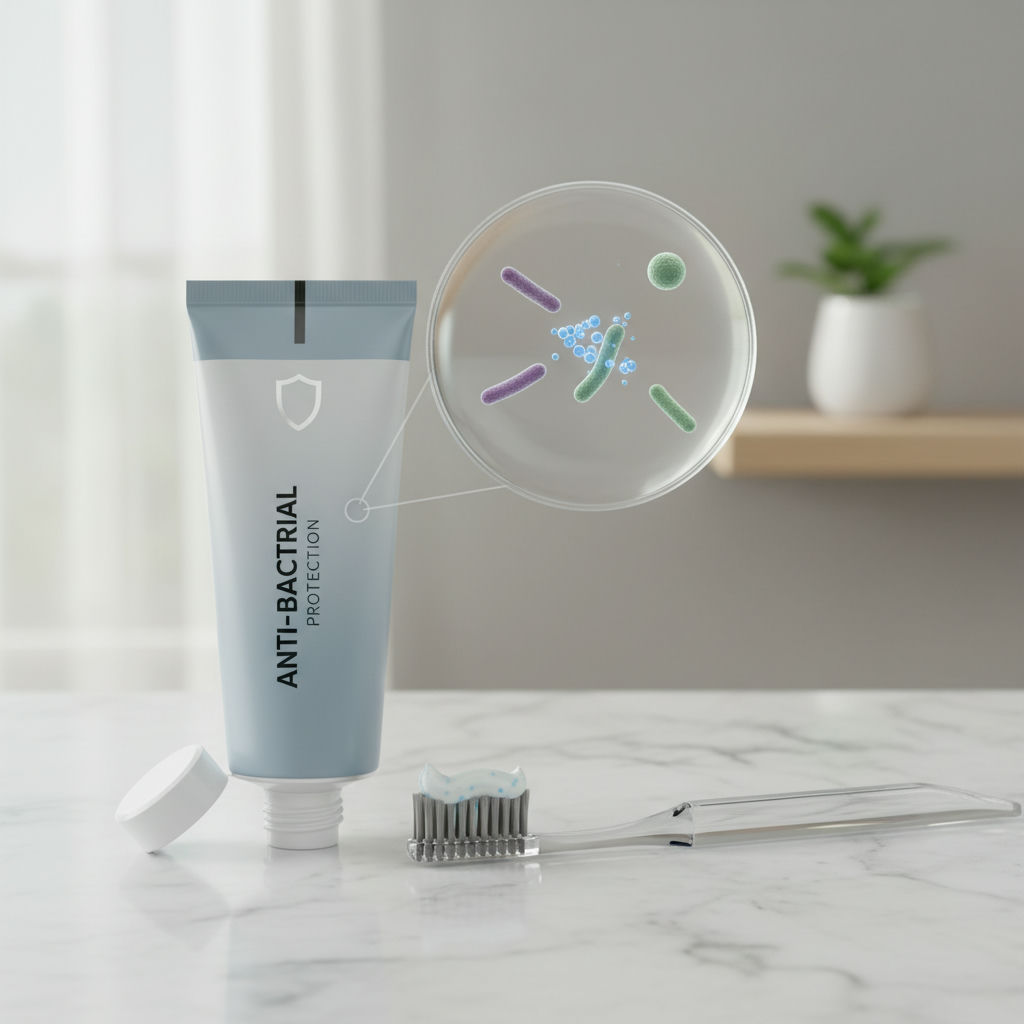
Gingivitis reduction. The American Dental Association notes that toothpastes may include ingredients that reduce gingivitis and tartar build-up and improve bad breath in addition to fluoride cavity protection. For stannous fluoride, the U.S. Food and Drug Administration has approved the ingredient for both antigingivitis and anticaries effects, and clinical summaries describe it as providing bacteriostatic and bactericidal properties that help fight plaque and gingivitis. Research summaries also point to substantivity, describing stannous ions as remaining at levels high enough to inhibit bacterial metabolism well after brushing.
Plaque to tartar prevention. Dental plaque is a structured biofilm where bacteria adhere to teeth and to each other. If not disrupted by brushing, it mineralizes into calculus, which creates a rough surface that holds more bacteria. Stannous fluoride toothpaste research describes reduced biofilm burden through retention on plaque and interference with bacterial adhesion and sugar uptake, which in turn may support reduction in calculus accumulation when combined with anticalculus agents like pyrophosphates.
Persistent bad breath. Chronic halitosis is driven largely by volatile sulfur compounds produced by anaerobic bacteria living in plaque, on the tongue, and under the gumline in people with gingivitis and periodontitis. By lowering the overall bacterial load and the inflammatory response from plaque, anti-bacterial toothpaste addresses the source of those compounds rather than masking odor with flavor alone.
These benefits have limits. No toothpaste removes established calculus or reverses advanced periodontitis, and it does not replace professional cleanings, interdental cleaning, and daily disruption of biofilm. None of this addresses a question specific to people already investing in a whiter smile: does fighting bacteria conflict with keeping teeth bright?
Combining Anti-Bacterial Toothpaste With a Whitening Routine Without Cancelling Either Out
You can use an anti-bacterial toothpaste alongside a whitening routine without one cancelling the other: keep twice-daily fluoride anti-bacterial brushing for gum health and apply whitening gel in a separate, clean-mouth window so neither job is diluted.
Precision Whitening On The Go.
The gingivitis and breath benefits are only valuable if they don't come at the cost of the bright smile someone is also working toward. That tension comes from timing, not chemistry. Stannous fluoride carries a well-known history of surface staining, with newer formulas generally considered less prone to it, and any residual paste, foam, or strong rinse right before whitening can reduce peroxide contact and leave more chromogens sitting on enamel.
Dentists generally advise a simple split: brush morning and night with your anti-bacterial fluoride toothpaste, rinse thoroughly with water, then use whitening later, either midday or at night after that second brush once the mouth is clear. Don't layer gel directly over fresh toothpaste foam, and avoid eating, drinking coffee, tea, or wine immediately after whitening while pores are more receptive. If you use an additional mouthwash, save it for the opposite end of the day from your whitening step.
A nano-hydroxyapatite whitening treatment fits this routine as a complement, not a replacement: it pairs whitening action with enamel repair, so you can maintain daily bacterial control with your regular fluoride toothpaste and run the whitening-and-repair step separately for brightness without compromise.
Who Should Prioritize an Anti-Bacterial Formula (And Who Should Choose Differently)
A common mistake is assuming anti-bacterial toothpaste is automatically the better choice for every mouth. It is most valuable when plaque bacteria drive bleeding gums, persistent odor, or fast tartar buildup, and less critical when sensitivity or enamel preservation is your top concern. The decision comes down to which formula fits your specific mouth and goals.
Prioritize an anti-bacterial formula if you:
- have a history of gingivitis, gum recession, or bleeding when you brush and floss
- struggle with persistent bad breath despite consistent brushing and interdental cleaning
- smoke, wear orthodontic appliances, or notice plaque returning quickly between cleanings
Consider a different priority if you:
- feel sharp sensitivity to cold, air, or sweets — you may get more day-to-day relief from a sensitivity-focused formula designed for dentin hypersensitivity
- see signs of early enamel erosion from acid or past whitening overuse — a remineralizing-first approach may matter more than maximal antibacterial action
Before buying, check the label for two things: the active ingredient that provides the antibacterial benefit, such as stannous fluoride or zinc citrate, and the ADA Seal of Acceptance which means the product met requirements for safety and efficacy and, for cavity-protection claims, contains fluoride.
Build a routine that covers both jobs without compromise: use a fluoride anti-bacterial toothpaste morning and night for biofilm control, and keep whitening and enamel repair as a separate step, not a toothpaste swap, so you protect gums and keep brightness.
Sources
- Toothpastes
- www.sciencedirect.com
- The clinical and microbiological efficacy of a zinc-citrate/hydroxyapatite/potassium-citrate containing toothpaste: a double-blind randomized controlled clinical trial
- The New Generation of Stannous Fluoride
- Stannous Fluoride: Pros and Cons, Vs. Sodium Fluoride
- ADA Seal of Acceptance
Frequently Asked Questions
Will anti-bacterial toothpaste wipe out good bacteria and disrupt my oral microbiome?
No, it does not sterilize your mouth. Actives like stannous fluoride provide bacteriostatic and bactericidal properties that suppress plaque bacteria in biofilm, but saliva and normal flora repopulate quickly. The goal is a thinner, less inflammatory biofilm, not a bacteria-free mouth.
I drink a lot of coffee and already get stains — will stannous fluoride make it worse?
Yes, it can. Extrinsic staining of teeth is a possible side effect of stannous fluoride toothpastes, and chromogens from coffee can make it more visible. The stain is surface-level and usually removed with a routine hygiene polish, and newer formulas are generally considered less prone to staining.
Is stannous fluoride safe to use with crowns, veneers, or implants?
Generally yes, it will not damage ceramic or titanium, and its antibacterial action can help around implant margins where plaque collects. The main issue is cosmetic — extrinsic stain can collect at crown margins or on rough composite. If you have extensive restorative work, ask your dentist to monitor stain and product choice.
Is zinc citrate as effective as stannous fluoride for bleeding gums?
They work differently. Stannous fluoride is bactericidal and has FDA-recognized antigingivitis and anticaries effects, with the strongest RCT support for gingivitis. Zinc citrate is bacteriostatic via inhibiting glucose metabolism of S. mutans and in a trial of 1450 ppm F showed 15.5% vs 6.8% S. mutans reduction, p=0.014, which is promising for breath and plaque but not a direct substitute for stannous fluoride for bleeding gums.
Can I use anti-bacterial toothpaste and then rinse right away with chlorhexidine or strong antiseptic mouthwash?
You can, but spacing improves both. Chlorhexidine and some antiseptic rinses can bind to the same biofilm sites and add to staining when paired immediately with stannous fluoride. Use your fluoride anti-bacterial toothpaste morning and night and shift mouthwash to another time of day, rinsing with water after brushing.
Should kids use anti-bacterial toothpaste or just regular fluoride toothpaste?
Most children need fluoride cavity protection first. Any ADA Seal toothpaste must contain fluoride and must undergo independent laboratory or clinical testing, so an anti-bacterial fluoride formula meeting those criteria is acceptable if recommended by their dentist. Supervise amount, encourage spit-not-swallow, and follow age-specific fluoride guidance.
How long does the anti-bacterial effect last after I brush?
Stannous fluoride shows substantivity, meaning stannous ions stay retained in plaque and on soft tissues for hours after brushing at levels that continue to inhibit bacterial metabolism. That residual activity is why plaque feels slower to rebuild, but it does not replace twice-daily mechanical disruption.
If I use anti-bacterial toothpaste, can I skip flossing or interdental picks?
No. Calculus accretions form due to mineralized plaque that no toothpaste can remove once hardened, and toothbrush bristles cannot fully reach between teeth. Anti-bacterial paste lowers bacterial load and helps prevent mineralization, but interdental cleaning and professional removal are still required.


